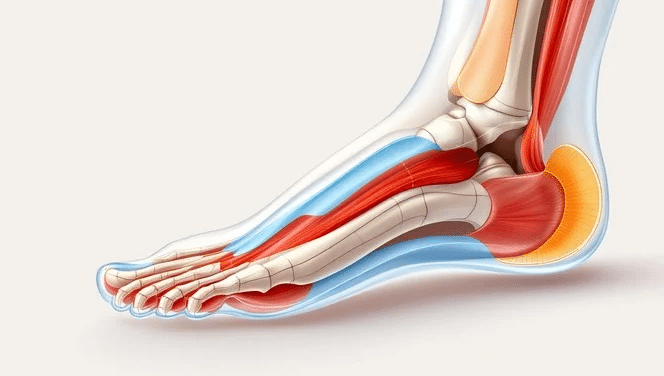
Hypermobility and Flatfoot-
Looking through a connective-tissue lens
Steven Gillingham, BSc MSc DPM — The Footnote / Southwest Foot & Ankle Centre (WA, Australia)
Article sourced from The Footnote
If you treat feet long enough, you meet the patient who makes textbook categories feel flimsy: beautiful arches that collapse after lunch, tendons that protest every training block, ankles that sprain when the breeze changes direction, and “flat feet” that are somehow strong in the gym yet unreliable on the stairs. That paradox lives at the intersection of connective tissue biology and load management, the hypermobility lens and it’s where progressive collapsing foot deformity (PCFD) stops being a vague bucket and becomes a set of solvable problems.
This article expands my recent symposium talk into a practical read for clinicians who already speak “hypermobile” and want sharper, clinic-ready moves. I’ll follow the scaffolding from the talk and why it matters, a pragmatic definition of hypermobility, a unifying pathomechanics story of PCFD, age-and-stage nuances in kids, red flags, the handful of tests that actually change decisions, and the treatment triad I come back to every day: align, protect, load.
Why this conversation, why now?
Because the words we reach for shape the care we deliver. “Flatfoot,” “pronation,” and “instability” are useful descriptors; they’re not mechanisms. Patients who sit somewhere on a hypermobility spectrum from “functionally bendy” through generalised joint hypermobility (GJH) to heritable disorders like hEDS/HSD, often get advice that’s either too fatalistic (“you’re just hypermobile”) or too local (“you need arch support”). In reality, most presentations make sense if you zoom out to connective tissue quality, motor control strategies, and load history over time. That lens gives you reasons, not just labels.
A broad, pragmatic definition of "hypermobility"
Clinically, I define hypermobility as excessive passive range for age/sex/ancestry in one or more joints plus atypical tissue behaviour under load which includes “giving way,” rapid end-range drift, or delayed force transfer that the patient experiences as fatigue, ache, or “floppy weakness.” We then ask: Is it local or generalised? Lifelong or acquired? Benign or part of a syndrome? That short flowchart prevents the two common misses:
- Over-pathologising the bendy teenager with good motor control who simply needs better dosing and shoes; and
- Under-recognising the adult with recurrent tendinopathy, dysautonomia symptoms, and a family history that absolutely justifies medical work-up.
Unifying pathomechanics --> PCFD (without hand-waving)
PCFD is not just “arches falling down.” It’s a systems problem that shows up locally. A hypermobility lens adds three recurring ingredients:
- Tissue permissiveness: Ligaments and fascia yield earlier, so midfoot and hindfoot coupling increases under everyday loads. The foot does the right thing (become a mobile adaptor) for too long, too easily.
- Motor strategy drift: When passive restraints are permissive, people “solve” tasks by riding end-range. That can look like perpetual late-stance pronation, toe gripping, or a peroneal-dominant gait that quietly deconditions the calf-posterior tibial complex.
- Accumulated load mismatch: Small day-to-day mismatches (work hours, childcare marathons, training swings, pregnancy/postpartum hormones) sit on permissive tissue and drifted strategy — and after months to years, you see the PCFD stack: talar head uncovering, spring ligament fatigue, tibialis posterior overload, a collapsing medial column that looks structural but started functional.
Once you see this triad, “flatfoot” stops being a shape and becomes a recoverable dynamic for many patients.
Not all hypermobility is created equal (the diagnostic buckets)
When your mechanism sense says “connective tissue,” your differential should stay wide enough to catch the important stuff:
- Heritable hypermobility disorders (hEDS/HSD and others). These patients often present with multi-site pain, easy bruising, delayed recovery, fatigue, autonomic features, pelvic floor issues, or a family history of “double-jointedness.” The foot is a loud messenger, not the whole message.
- Rheumatic/inflammatory states (RA, PsA, JIA). Inflammation can loosen restraints, alter motor control, and accelerate ligamentous fatigue. Feet are often early signposts.
- Metabolic/neuropathic (diabetes, early Charcot physiology). Loss of protective sensation or autonomic dysregulation changes how patients load and recover; permissive tissue + diminished feedback is a risky mix.
- Hormonal states (pregnancy/postpartum). Relatively normal arches become mobile adaptors on a timeline, with different expectations for recovery. Shoe strategy, bracing windows, and graded reload matter more than “permanent supports.”
Keeping these buckets visible makes your plan safer and your patient education more honest.
Kids: mechanics vs hypotonia vs syndromic
Most paediatric “flatfoot” is developmentally appropriate, especially in the under-eight crowd. Add hypermobility, and you’ll see wider bases, faster end-range drift, and fatigue with long days. The questions that separate reassurance from deeper work-up:
- Are we looking at benign mechanics (normalising arch profile with heel raise, robust single-leg balance for age, good hop control), hypotonia (struggles to hold shape even with cues), or syndromic flags (family history, growth outliers, skin/tissue signs, persistent pain, frequent sprains)?
- Does the foot become a stiff lever when you help it into alignment (promising), or does it stay mushy (consider systemic contributors, and plan longer for motor learning)?
In kids, the goals are energy efficiency, confidence, and skilled play — not “fixing” an arch. Devices are tools for learning, not prostheses for life.
Red-flag radar (refer, image, and/or co-manage)
- Night pain, constitutional symptoms, or relentless inflammatory morning stiffness.
- Focal bone tenderness that doesn’t reconcile with mechanics; non-mechanical swelling.
- Neurologic changes (new weakness, altered sensation), rapid deformity, or suspicion of early Charcot in at-risk patients.
- Syndromic features in a child (connective tissue skin signs, dysmorphism, growth concerns) or adults with multi-system involvement.
These are not “don’t treat” flags, they’re “don’t treat alone.”
The exam and tests that change decisions (and the ones that don’t)
You don’t need an hour, but you do need signal:
- Age-aware GJH screen. Use an age-appropriate Beighton threshold and the 5-part historical questionnaire to anchor whether you’re seeing “lifetime bendy.” This frame shapes expectations, not just today’s prescription.
- Functional end-range audit. Watch for prolonged late-stance pronation, toe gripping, or “peroneal bracing.” Then cue alignment: can they create a foot tripod and hold it through sit-to-stand, calf raises, hops?
- The lever test (can the foot stiffen?). Help them align (manual heel neutral + mild midfoot squeeze). If the calf raise becomes powerful and pain-reduced, you’ve found responders to alignment strategies.
- Segment-by-segment palpation + provocation. Spring ligament/superficial deltoid tenderness, tibialis posterior along the watershed, sinus tarsi irritability, peroneal retromalleolar glide. You’re mapping the over-doers.
- Selective imaging. Weightbearing radiographs when you need to stage PCFD, rule fracture, or plan bracing/orthoses. Ultrasound if you need tendon confirmation to progress loading. MRI when the story refuses to add up.
- Bloods and referrals. If your history surfaces multi-system signs, fatigue, inflammatory patterns, or autonomic features, co-manage with GP/rheum/genetics as appropriate. The podiatric plan is stronger with the systemic context.
Treatment principles: align, protect, load
I use this order deliberately. Alignment is not orthotics-worship; it’s giving levers a chance. Protection is time-bound, not learned helplessness. Loading is graded skill + strength, not vibe-based exercise.
1) Align (make force transfer possible)
- Footwear first. Firm heel counters, torsional control, forefoot stiffness matched to task. Shoes that let the calcaneus behave and the first ray contribute.
- Device logic. Use shells or braces to create a reliable neutral window, not a permanent crutch. Think: medial column support for the habitual “mobile adaptor,” lateral column cueing for peroneal-dominant strategies, and occasional AFO windows when pain or deformity demands it.
- Taping/straps. Elastic “directional” cues are brilliant for short-term learning and symptom control.
2) Protect (buy tissue quiet and motor clarity)
- Dose the calendar, not just the exercises. Cut the step count peak, redistribute standing tasks, swap impact for bike/row in the angry week.
- Hold a pain floor. Ask patients to keep pain ≤3/10 at rest and ≤5/10 in tasks for the first fortnight. Pain is a teacher; it’s a terrible coach.
- Respect tissues with slower clocks. Spring ligament/deltoid complex, posterior tibial tendon, plantar fascia — these don’t read your three-week goal calendar.
3) Load (own alignment through strength & skill)
- Heavy-slow calf work (knee straight + bent), posterior tibialis bias through controlled inversion/plantarflexion, and intrinsic-extrinsic integration (tripod balance → heel raise → forefoot rocker control).
- Motor control sequencing. Static tripod → sit-to-stand → step-downs → hops → short-ground contact times. Cue the shape first, then chase power.
- Return-to-run/play criteria. Symmetrical single-leg heel raise count and quality, three sets of quality step-downs without drift, hop-and-stick control. If they can’t own the foot, they’re borrowing it.
Children: evidence-aware orthoses & motor control (without creating dependence)
- Orthoses are a classroom. Use them to create a consistent “learning environment” while you build balance, hops, skipping, and age-appropriate plyometrics. The dose is most of the school day, clarified weaning during quiet phases, and no orthoses for identity (“you’re broken without them”).
- Shoes as curriculum. Flexible but not floppy; the younger the child, the more we prioritise stability for play over minimalist ideals.
- Measure what matters. Fatigue distance, stumble counts in sport, hop quality, parental reports of “keeps up with peers.” The arch photo album is the least interesting data point.
Practical clinic checklist (what I actually write in notes)
- Working mechanism (connective tissue permissiveness + strategy drift → PCFD features).
- Stage (pain dominant vs power-limited vs deformity-stage).
- Alignment tools chosen (shoe class + device + tape).
- Protection window (calendar + floor of tolerated pain + “don’t-do” swaps).
- Loading plan (2–3 key moves, clear reps/tempo, weekly progression rule).
- Outcome metric (function first: stairs, distance, time-to-fatigue).
- Systemic threads (what we’re watching; who we’re writing to).
Case sketches (because principles become real in stories)
1) The runner who “can’t feel push-off.”
30-something with GJH, two prior “tib post” flares. In clinic, prolonged late-stance pronation and toe gripping; calf raise weak and painful. With manual midfoot squeeze and heel neutral, calf raise becomes strong and quiet. We commit to firm counter footwear + medial posting shell (for 12 weeks), protect with run-walk swaps and step-count caps, and load with heavy-slow calf + tib post bias + short-ground-contact hops. Four weeks: pain calm, cadence up; 12 weeks: shells become race-day only.
2) The postpartum teacher with end-of-day collapse.
Device window and shoe change reduce “end-range living.” We change the day (sit-to-stand task breaks, staff-room calf raises, pram-walk hills out, flats in) while we teach a tripod that survives fatigue. Language matters: “You’re not broken. Your tissues are permissive right now; we’ll teach your system to share the load again.”
3) The 10-year-old “slow runner.”
Benign mechanics + hypermobility + fatigue. Orthoses for a season to create stability at school, then turn them into a game: hop courses, skipping tricks, single-leg balance challenges. Parents track “keeps up at recess” and stumble counts. The arch will do what arches do; function is the goal.
What to say (and not say)
- Say: “We’ll make your foot a better lever and teach your system to use it.”
- Avoid: “We’re fixing your flat feet.” It’s not false, it’s just unhelpful.
- Say: “Devices are temporary teachers; strength and skill are your forever tools.”
- Avoid: “You’ll need support forever.” (Sometimes true in deformity, rarely helpful early.)
Where I collaborate
- GP/rheum/genetics when the story is multisystem or inflammatory.
- Physio/exercise physiologist for global conditioning and graded return.
- Orthotist for AFO windows in painful deformity or neuro/Charcot risk.
- Women’s health physio in pregnancy/postpartum where pelvic and foot stories intertwine.
Take-home messages (the short version)
- Hypermobility converts flatfoot from a shape to a dynamic.
- PCFD is usually tissue permissiveness + motor strategy drift + cumulative load mismatch; treat all three.
- Align → Protect → Load is not a slogan; it’s the order that makes force transfer possible and durable.
- In kids, measure function and confidence, not arch photos.
- Keep your red-flag radar switched on and your referral network warm.
A final Footnote
Patients arrive with foot shapes; they leave with movement stories. If we help them write better ones — with clear mechanisms, time-bound supports, and skills that stick — the arch tends to behave, the tendon tends to forgive, and the person tends to get their life back. That’s the work. That’s the gift.
This article follows the structure of my Hypermobility & Flatfoot symposium presentation and extends it for clinic use.